
Let’s be real: Most of the mess in a busy household doesn’t come from a big ol’ disaster. It’s usually the daily drip of stuff piling up in the same places over and over again:
- Shoes and discarded socks that multiply by the door
- Mail and school papers that always seem migrate to the kitchen counter
- Random toys, water bottles, sunglasses, and hair accessories that congregate on every surface
It’s the kind of clutter that sneaks in during the day-to-day of conquering your endless to-do list and keeping everyone alive and well.
But it adds up to make your home feel chaotic. And it can leave you feeling both cranky and defeated.
Because how can you ever get on top of the mess without shelling out cash for a cleaning service or miraculously finding more time (and energy) in your already-busy day?
But I’ve got good news: You don’t need more time, energy, or even to suddenly turn all your family members into cleaning machines.
Your house just needs a system in place.
And one of the easiest, cheapest, and most sanity-saving systems out there is simply placing strategic bins throughout your home.
I know, it probably sounds way too easy to work. But it’s true.
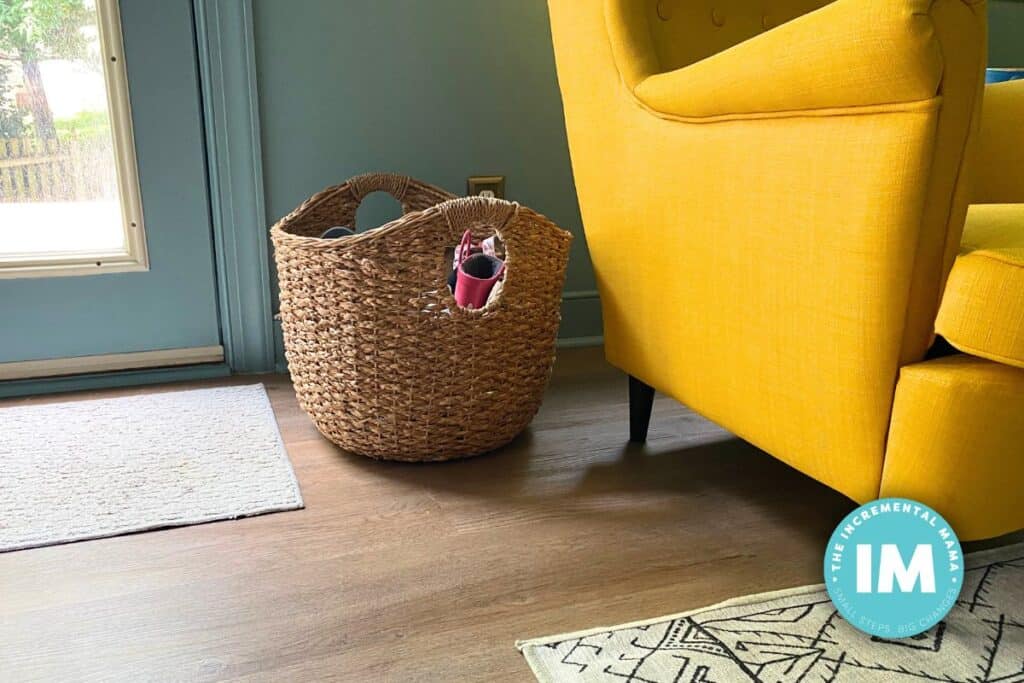
Why Bins Work to Organize Your Home
Bins work because they give everything a clear, consistent home in a convenient place…which is often the missing piece in areas where clutter keeps piling up.
In a busy household—where you’re juggling a million things at once—you need fast, low-effort solutions that work for everyone.
And that’s where labelled bins come to the rescue.
They help you contain the mess with minimal effort, and they make it easier for your kids (and let’s be honest, your partner) to both know where things go…and then actually put them away.
The key is to place bins strategically in clutter-prone zones. And to label them so it’s clear to everyone what belongs inside.
Instead of getting dumped on the floor or a counter top, it’s just as easy for everyone to dump the item in its appropriate bin.
When your kids know that school papers go in this bin and dirty socks go in that one, they’re much more likely to help (or at least, much less likely to pretend they don’t know where things go).
Even if what’s inside the bin isn’t perfectly organized, at least the chaos is contained. Bins reduce visual clutter and simply make it easier to keep your home clean and tidy.
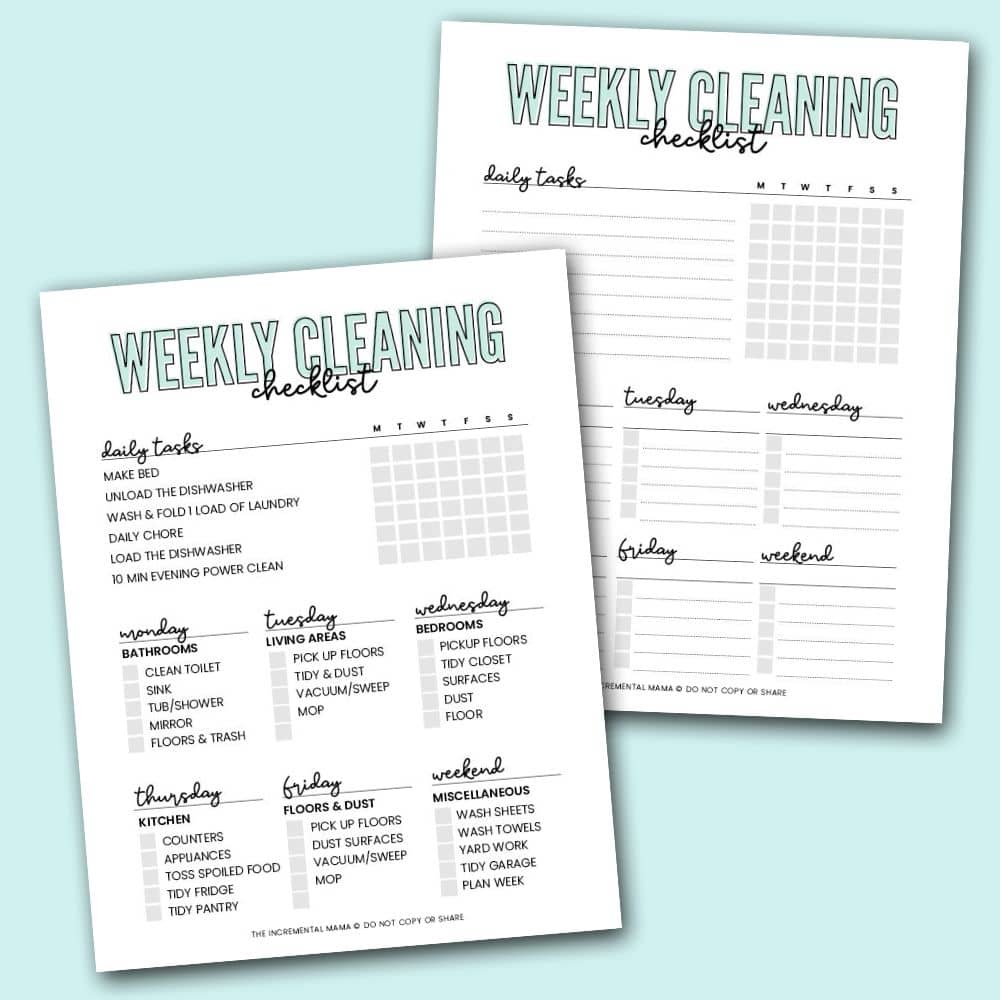
Free Weekly Cleaning Schedule
Ready to keep your home clean and tidy with minimal effort? Grab the free Weekly Cleaning Checklists which include:
- Easy Weekly Cleaning Schedule
- Blank Template to customize
How to Use Bins to Control Clutter Hot Spots in Your Home
As a mom of 4, there are few things I’ve found more helpful in getting my family to put things away than placing labelled bins in problem areas. Because when done correctly, all I have to do is put the labelled bin in place and then suddenly things just stay cleaner.
Here are the exact steps to use bins to control clutter in your home’s messy spots:
1. Identify Clutter Hot Spots & Problem Items
Start by taking a walk through your house and noticing the areas that constantly attract mess—no matter how many times you clean them.
Is it the kitchen counter? The entryway? The bathroom sink? Once you spot the hot spots, ask yourself: What keeps piling up here?
Things like:
- Paper clutter (mail, school stuff)
- Shoes and socks
- Toys and books
- Hair accessories
- Random “I’ll put it away later” items
Think about what items can be categorized into a bin.
2. Get an Appropriate Bin
Now that you know what needs a home, grab a bin that fits:
- The size of the items
- The space it will live in
- Your style or decor (because you’ll be more likely to maintain it if you don’t hate how it looks)
Don’t overthink this. Use what you already have—a basket, a plastic tub, even a cardboard box works to start. You can always upgrade later.
For example, below you can see the absolute hodgepodge of bins used in the little closet where I store a lot of our cleaning supplies. While I like cute baskets in visible areas, this is pure function over beauty!
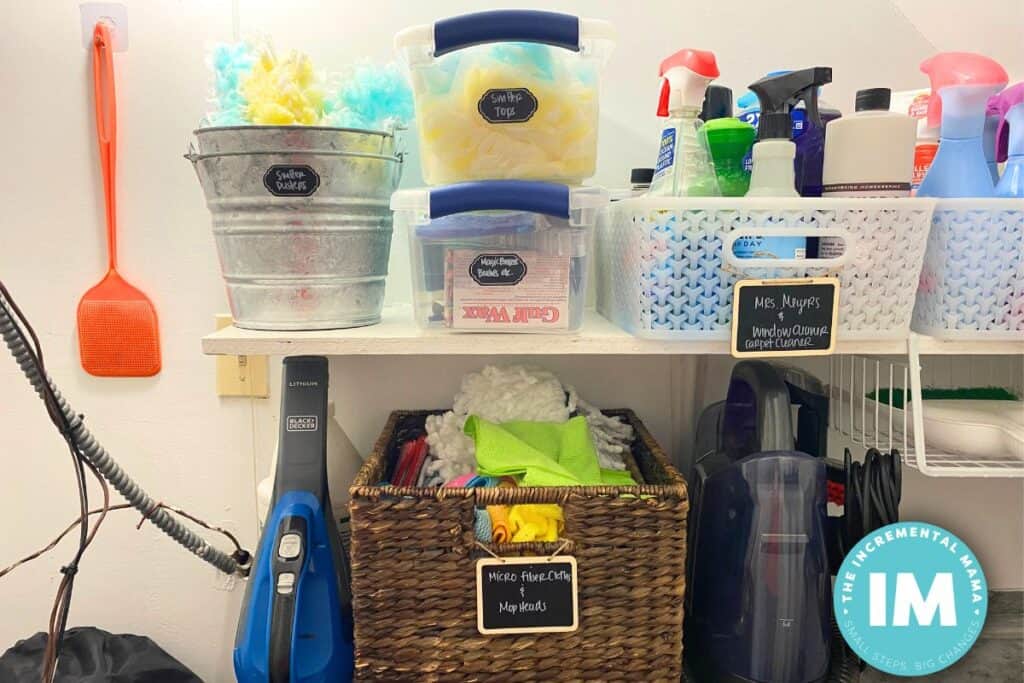
My favorite kinds of bins to use:
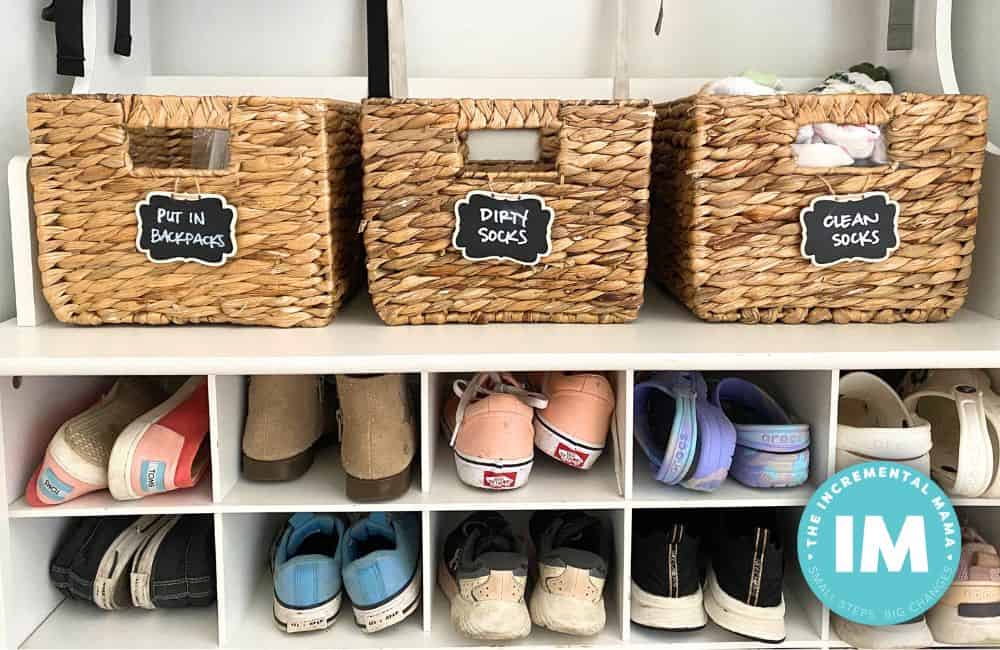
Personally, I use a lot of these cute of storage baskets with these chalk label tags in high traffic areas throughout my home, like entryways.
Under sinks, in the fridge, or in the pantry, I use clear bins like these with sticker labels like these.
3. Label the Bin
This is key, es[pecialy when kids are involved. Honestly, a well-placed bin is like 40% of the solution and labels are the additional 60%. Whenever there is any problem zone in our home, I’m always like “What can I label?”
Drawers, bins, hooks…I label it all!
Labels take away the guesswork for your kids (and partner) and make it easier for everyone to use the system without asking you where things go every five minutes.
Handwritten, printed, chalkboard-style—it doesn’t matter. Just label it.
Note that I don’t actually label EVERY SINGLE bin. If they’re bins only I really use or the use has been well established, I may skip the label (like the baskets in the blue organizer by the door to the garage that you can see further down the post).
4. Stick It in the Problem Area
Place the bin exactly where the clutter naturally collects.
Don’t fight human behavior—work with it.
If shoes get dumped by the door, put the shoe bin there. If papers land on the kitchen island, put the “Inbox” bin on the kitchen island (at least to start out). It might feel obvious, but this step makes all the difference.
The bin might go in a bookshelf, on top of a console, inside a cabinet, or on storage shelves.
5. Get the Family on Board
No, this doesn’t mean your kids will suddenly become neat freaks. But it does mean you’ll show them the bin and explain what goes in it. Keep it simple. Repeat yourself a lot. Celebrate when they use it correctly.
Try:
- “Hey, from now on, school papers go in this bin.”
- “This is where your socks go when you take them off after school.”
- “If it doesn’t have a home, it lives in the ‘Put Away Bin.’”
Even small buy-in can create big results over time.
6. Adjust As Needed
Like all things in mom life, this is a living system. If a bin overflows constantly, it might be too small. If no one uses it, maybe it’s in the wrong spot or needs a clearer label.
Tweak as you go:
- Switch up bin locations
- Change labels
- Upgrade bins when it’s worth it
- Get rid of bins that aren’t helping
Progress over perfection. The goal isn’t Pinterest-perfect organization—it’s function.
If it makes your life easier? It’s working.
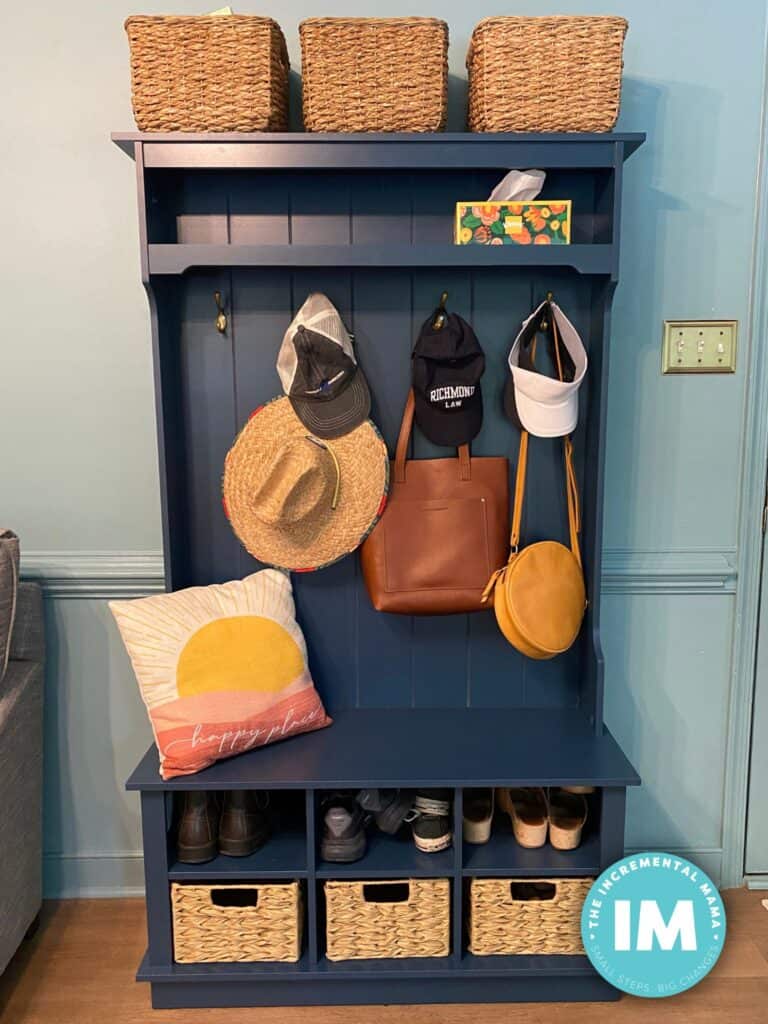
What Baskets or Bins Work Best for Organizing
There is no “right” bin or storage basket. It’s finding what works for you considering function and aesthetic.
Consider the size you need, your budget, and your style or decor when finding the right bins for you.
Some storage bin options:
- Water Hyacinth Baskets: I love using bins like these in high traffic areas because they’re super cute and look great with my decor. I then use these chalk label tags.
- Clear Plastic Bins: These are great for organizing items in pantries, closets, or under sinks. They can be used with sticker labels like these.
- Woven Storage Bins: Woven bins are great for storing blankets, bedding, toys, clothes, or other soft items.
- Mesh Metal Bins: These can be great for the kitchen, pantry, or on shelves.
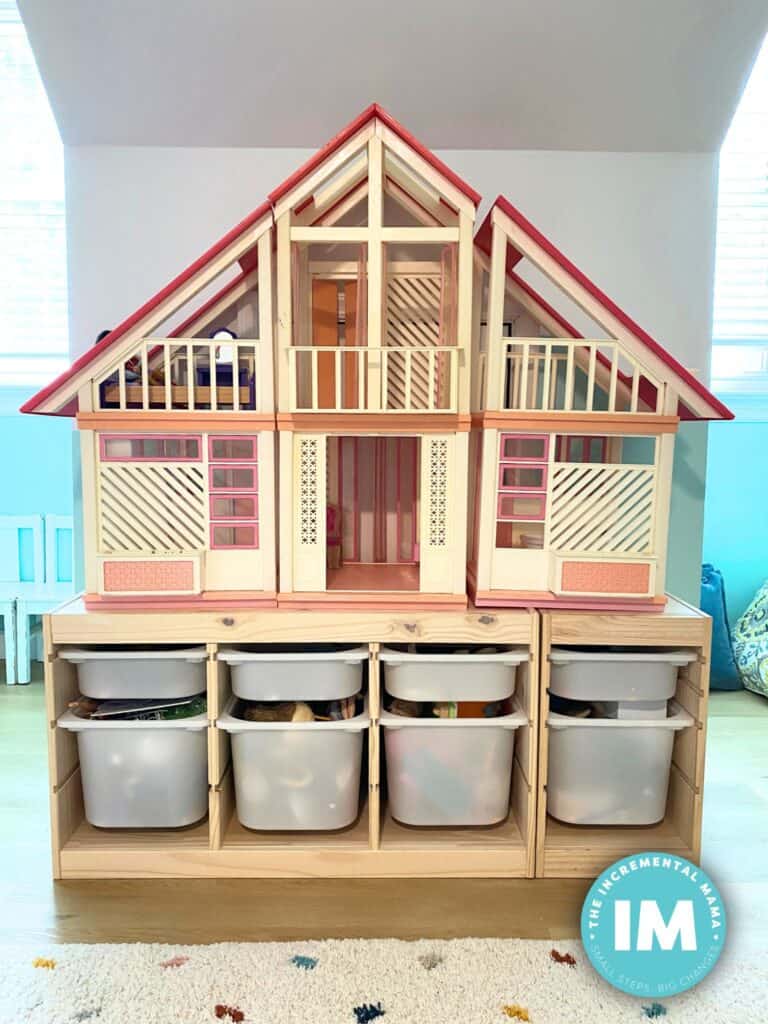
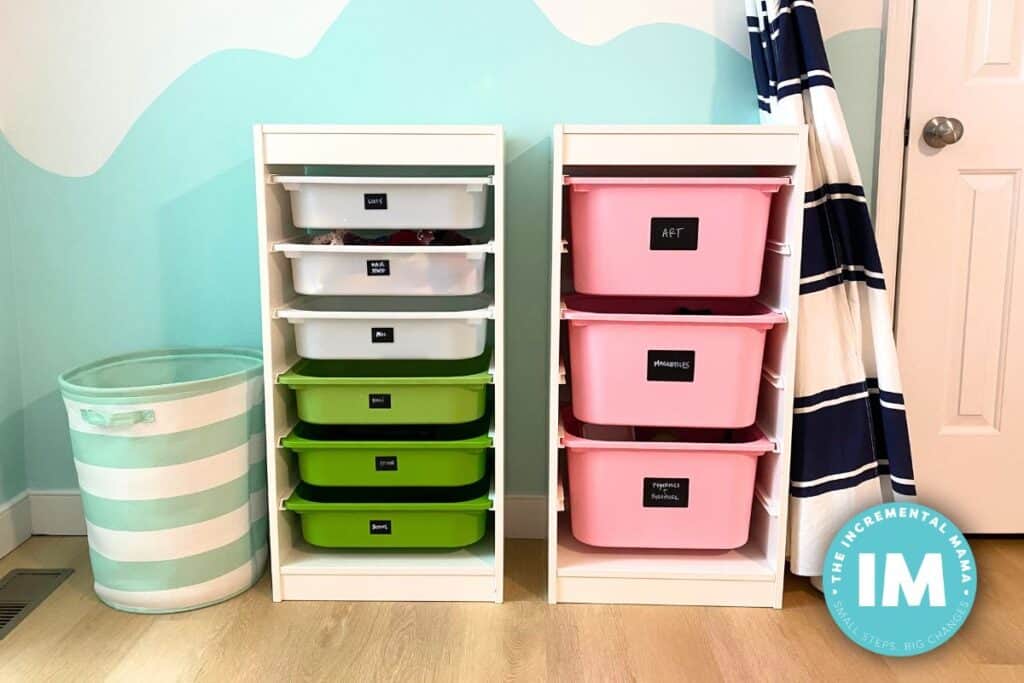
- Trofast System from IKEA: These bins are awesome for kids bedrooms.
Consider what you’re storing, your space, and your decor to pick what works best for you. Personally, I use all of the above kinds of storage bins in my home, as you can see from the pictures in this post.
Room-Specific Ideas for Using Bins to Organize Clutter
With those steps in mind, let’s now dive into specific storage bin ideas for the areas around your home. As you go through these ideas below, think about your home and which ideas will be most helpful for you.
The Entryway: The Daily Drop Zone
This is probably the most common problem area for folks. Because, for whatever reason, when walking in a door one is simply overcome with the desire to just start dropping everything.
Note that this may be the front door entryway or by the door to the garage.
(In our home, we have organized bins, hooks, and shelves in both locations or else we’d be drowning in clutter.)
Bin ideas for the entryway:
- Shoes
- Lunchboxes or other school items
- Mail and packages
- Seasonal accessories: gloves, hats, sunglasses, etc.
- Keys & wallets
- Reusable shopping bags
- Water bottles
One of the first bin systems I ever created was in our entryway for both clean and dirty socks. Because with 4 small kids, socks were the absolute bane of my existence.
Now, dirty socks immediately go in the dirty sock bin right when they take their shoes off. And when clean socks are folded, they go straight to the clean sock bin. It’s a once stop shop for shoes and socks!
The Living Room: Where “Stuff” just happens
This is the room everyone uses and stuff just naturally accumulates. And if certain items accumulate there, consider creating bins for them and storing them in the living room.
(For us, that’s a whole lot of drawing and art paraphernalia, games, and books.)
Bin ideas for the living room:
- Rotating toy sets
- Cozy items like blankets and pillows
- Books or magazines
- One small bin per kid for “their stuff they leave everywhere”
- Books
- Remote controls or game controllers
- Crayons, markers, coloring books
Kitchen Counters: Where Papers (and everything else) go to die
I’m not sure what it is about a clean counter top, but it makes people just itch to put stuff down on it.
Bin ideas for the kitchen counter:
- Mail and school papers
- An “action bin” for stuff you need to deal with (permission slips, bills, etc.)
- Kids’ artwork (temporary holding zone before display or storage)
- Receipts and random coupons
Consider keeping these bins small (so as not to be an eyesore) and be sure to regularly purge them so they don’t become clutter bins.
Bathroom: Small Items, Big Mess
Tiny things everywhere, especially if you share the space with kids. This is one place where small baskets or bins can be especially useful, especially in organizing bathroom drawers or closet shelving.
Bin ideas for the bathroom:
- Hair stuff (brushes, bows, clips, products)
- Bath toys (look for bins with drainage holes!)
- Individual bins for each kid’s toothbrush/toothpaste
- Travel-size or backup products
- Dental care items
- Cleaning supplies
- Cotton swabs
- Medicine or first aid items
Use bins inside drawers, on shelves, and under the sink to contain the chaos.
Kids’ Bedrooms: So. MUCH. STUFF.
If your kid is a little packrat, hoarding a mix of kids’ meal toys, literal garbage, stuffed animals, and random toys…
Rest assured: that’s totally normal. But of course, that kind of chaos is just going to drive you crazy. Labelled bins can help organize the chaos in a way your kid can maintain.
Personally, we love the Trofast Storage system from IKEA for our kids rooms. With different bin sizes, they’re awesome for all kinds of toys, keepsakes, and art supplies.
Bin ideas for kids’ bedrooms:
- Specific small toys (like Legos, action figures, doll clothes etc.)
- Stuffed animals
- Art supplies & paper
- Activity-specific gear (dance, soccer, scouts)
- Dress up clothes
- Keepsakes or special treasures (limit to 1 bin per kid)
- Dirty clothes
Let kids help sort their stuff into bins—it gives them ownership and helps them learn organizing skills.
Bonus tip: Label drawers (in addition to bins) to help kids keep organized.
Laundry Room
The laundry room is the engine of your home, with basically every clothing item, towel, rag, and piece of bedding rolling in and out on a regular basis. Bin can help keep that engine running smoothly.
Laundry Room Bin ideas:
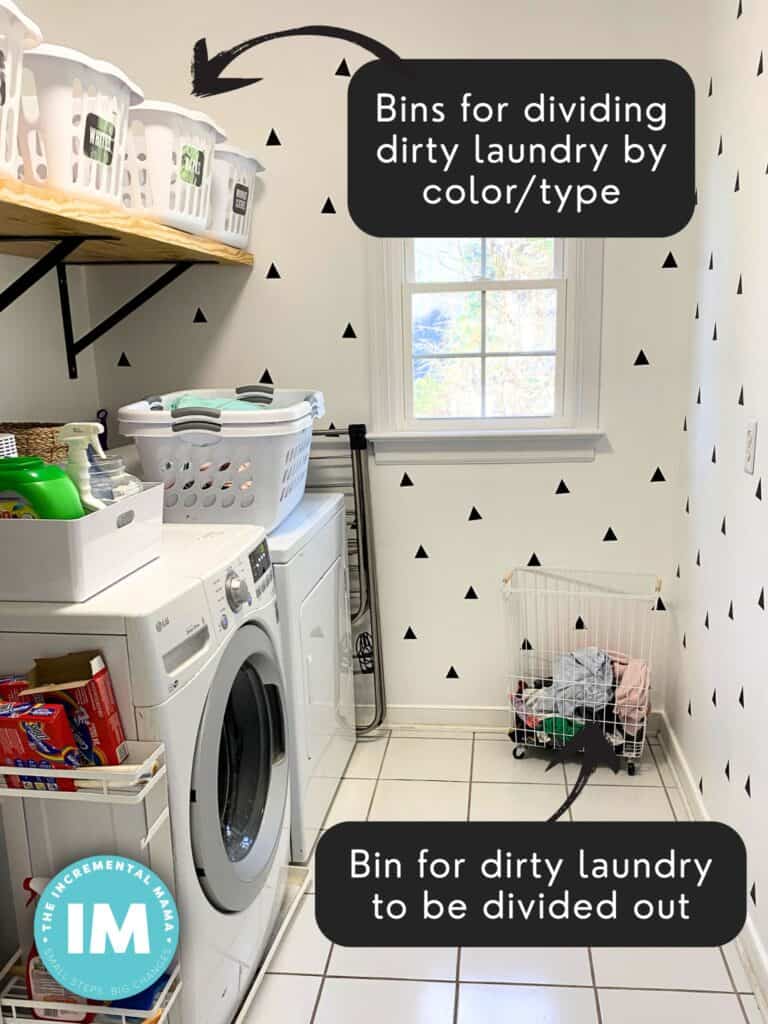
- Divided laundry (i.e. whites, lights, colors, towels, bedding etc)
- Clean socks without a partner
- Found-in-pocket surprises (coins, LEGO heads, hair clips)
- Stain treatment supplies
- A clean laundry bin for each family member
- Items that need to be treated for a stain
As part of my laundry system, I have labelled bins for dividing out dirty laundry and a wire rolling bin for items that need to be divided. See image below.
Another Option: The Catch-All Bin
Another bin that can be used basically anywhere is the “Catch-All” bin. This is a bin that anything that either needs to be put away or doesn’t have a place can go.
This can be handy for quickly cleaning up a space to welcome company or to simply just tidy up your space so you can relax.
Depending on your home, this might be a good option for high traffic areas you want to quickly tidy.
However, the problem with the “Catch-All” Bin is that the pile inside can just grow and grow unless you also have a system in place to deal with the items.
Personally, these don’t work for me because I am the only one who would try and clear out the bin. Instead, I find that having specific labelled bins is most effective for my home and family.
But depending on your home and personality, this might be a good option for high traffic areas you want to quickly tidy.
Bins + Labels = Fewer Messes
Most of life’s problems can’t be solved easily. But clutter hot spots?
A few $5 bins and some labels might just do the trick.
They won’t magically make your house spotless or your kids pick up without being asked.
But they will give your home structure, reduce visual clutter, and make life feel just a little more manageable. You’ve got this!

Leave a Reply